Modem M16 FAQ🔗
Below are some frequently asked questions about the Modem M16. Click on a question in the table of contents to the right or simply scroll down to read the FAQs.
1. Can the M16 modem measure the range/distance between two modems?🔗
No. The modems are unsynchronized and the M16 is not designed for time-of-flight ranging. Range estimates based on its timing will have large errors, for two reasons:
- Transmit side: The exact time of the acoustic transmission is not available on the interface. The TX_COMPLETE flag is raised within approximately 25 ms after the acoustic transmission, but the exact delay varies.
- Receive side: The modem decodes packets continuously and does not use a sync word. The point where a packet is registered as received is therefore not fixed relative to the acoustic arrival, and can vary by up to roughly half the duration of the acoustic transmission.
In water, these timing uncertainties correspond to path errors from tens of metres up to several hundred metres, which makes time-of-flight ranging impractical.
However, the Signal to noise ratio (SNR) can give a rough indication of whether the other modem is near or far: a higher SNR generally means the modems are closer to each other.
2. Do the modem retransmit data packets?🔗
Yes, If the modem is set to parrot mode (see Parrot Mode), it will retransmit all packets it has received.
3. Does the modem need line of sight to communicate between them?🔗
Yes, they do.
4. Can the modem be mounted below a shell on an ROV?🔗
No, the transducer part of the modem must be in the water to be able to send and receive signals.
5. How should the modem be mounted to achiecve the best possible signal strength🔗
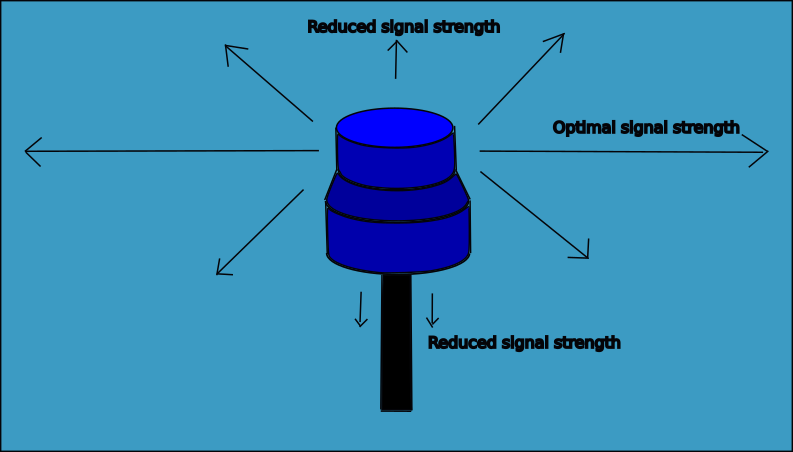
The signal strength from the Modem-M16 is donut-shaped around the transducer.
Below is a simple scetch that illustrates the signal strength in all directions. For shorter distances the mounting is not relevant, as the signal is transmitted in all directions and also reflected at the surface, seabed or other constructions in the water. On long distances or to achieve optimal behaviour, the mounting position might slightly impact the signal range of the modem.
6. How fast can the modems move relative to each other?🔗
The two modems should not move faster than 0.8 m/s relative to each other. See Acoustics.
The limit comes from the Doppler effect. When two modems move towards or away from each other, the received signal shifts slightly in frequency. The M16 gets its long range on very little power by using a narrow frequency band and long packets, so it can only correct for a small shift. Up to about 0.8 m/s that works fine. Above that, packets start to fail and are dropped.
Two things help in practice:
- Only the speed directly towards or away from the other modem counts. Moving sideways around it has almost no effect.
- It is the relative speed between the two modems that matters, not speed over ground. Two vehicles traveling together at the same speed are not affected.
Situations like a winch lowering a modem quickly, or a boat moving up and down in waves, can be enough to go over the limit on their own. If you need to communicate while under way, slow down or hold position for the duration of the transmission, which is 1.6 seconds per packet.